
Dating Montenegro’s business cycle
Part 3 moves from forecasting GDP to identifying Montenegro’s business cycle. A business cycle is the movement of economic activity around its longer-term trend. This is not the same as asking whether GDP rose or fell in a single quarter. An economy can still grow while being below trend, or slow while remaining above trend. Filter-based dating therefore gives a more nuanced picture of macroeconomic phases.
This analysis compares three filters: Hodrick-Prescott, Baxter-King and Corbae-Ouliaris. Each separates trend and cycle differently. The goal is not to claim that one filter gives the true cycle, but to identify the episodes that are robust across methods.
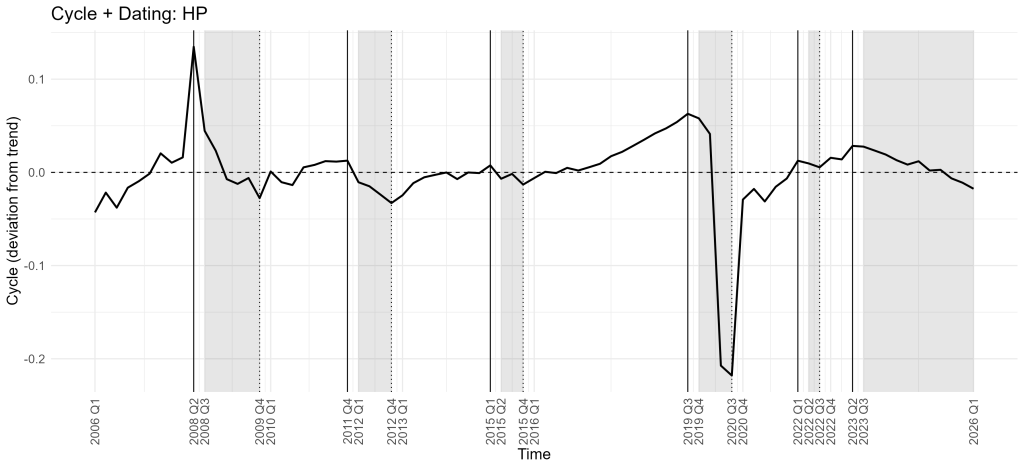
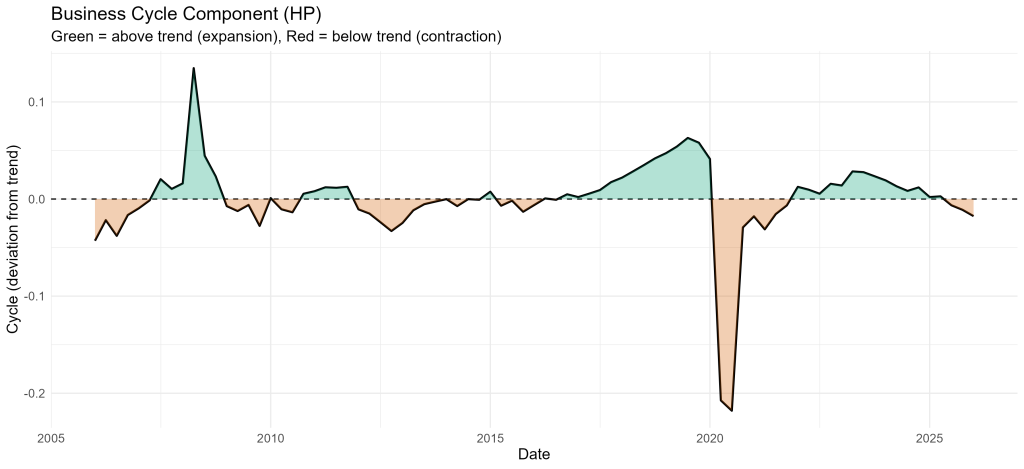
The Hodrick-Prescott filter classifies Montenegro as being in expansion for 51 quarters and contraction for 30 quarters. It identifies an early expansion from 2006Q1 to 2008Q2, followed by contraction from 2008Q3 to 2009Q4. A renewed expansion runs from 2010Q1 to 2011Q4, followed by a shorter contraction in 2012. The period from 2013Q1 to 2015Q1 is again above trend, while 2015Q2–2015Q4 is below trend. A longer expansion follows from 2016Q1 to 2019Q3. The pandemic contraction is dated from 2019Q4 to 2020Q3, and it is the deepest cyclical event in the sample. After that, the HP filter shows recovery from 2020Q4 to 2022Q1, a short contraction in 2022Q2–2022Q3, another short expansion from 2022Q4 to 2023Q2, and then a persistent below-trend phase from 2023Q3 to 2026Q1.
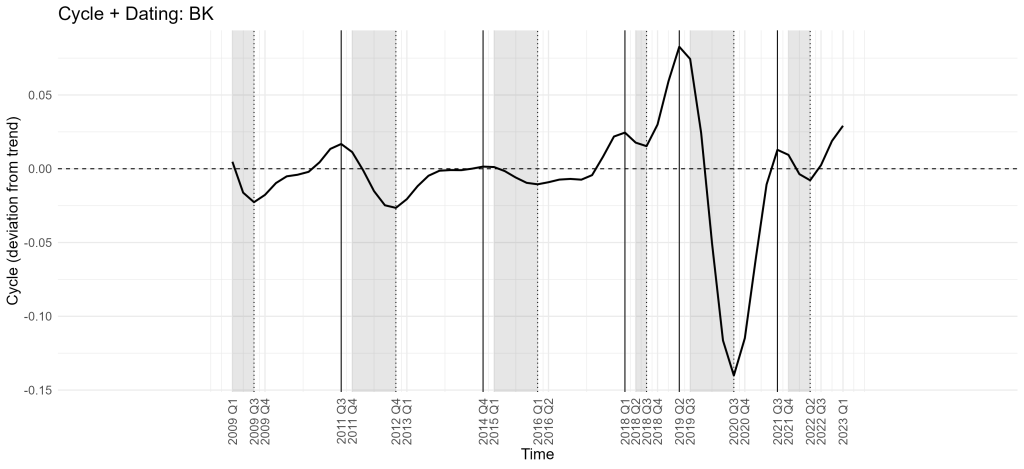
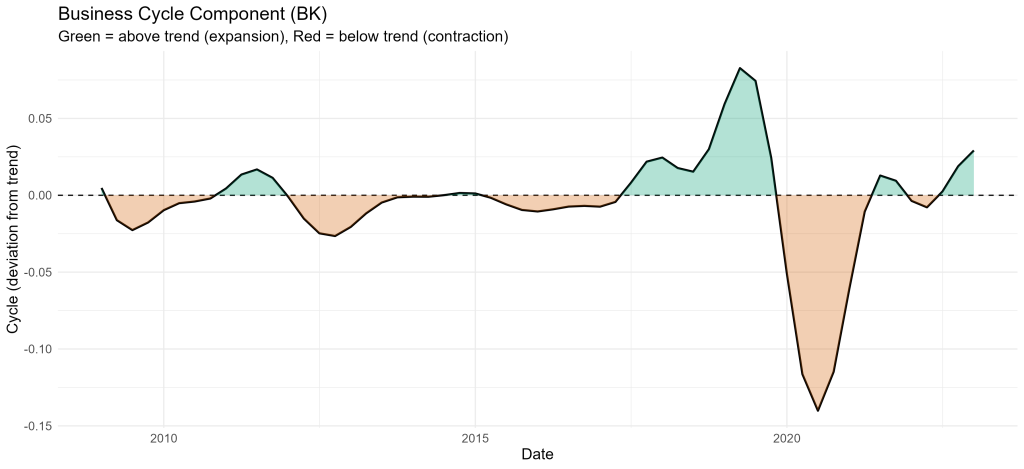
The Baxter-King filter gives a smoother but shorter view because it loses observations at the beginning and end of the sample. It identifies contraction in 2009Q1–2009Q3, expansion from 2009Q4 to 2011Q3, contraction from 2011Q4 to 2012Q4, expansion from 2013Q1 to 2014Q4, and contraction from 2015Q1 to 2016Q1. It also captures expansion from 2016Q2 to 2018Q1, a short contraction in 2018Q2–2018Q3, and another pre-pandemic expansion from 2018Q4 to 2019Q2. The pandemic contraction runs from 2019Q3 to 2020Q3, followed by recovery in 2020Q4–2021Q3. The filter then shows contraction from 2021Q4 to 2022Q2 and expansion from 2022Q3 to 2023Q1. It cannot fully assess the latest years because of endpoint loss.
The Corbae-Ouliaris filter records 44 expansion quarters and 37 contraction quarters. It differs from HP in some early and later details, but agrees on the major events. It identifies contraction from 2006Q4 to 2009Q1, a brief positive phase in 2009Q2–2009Q3, and then contraction again in 2009Q4–2010Q2. It shows a long expansion from 2010Q3 to 2013Q4, contraction from 2014Q1 to 2015Q4, and several shorter phases before the pandemic. It dates the pandemic contraction from 2019Q3 to 2020Q3. Unlike HP, it shows a long above-trend phase from 2023Q2 to 2025Q3 before turning negative again in 2025Q4–2026Q1.
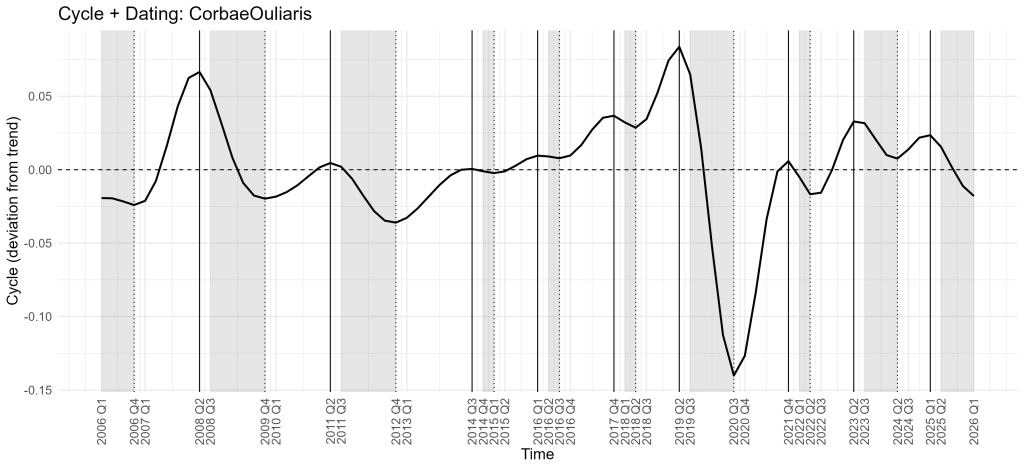
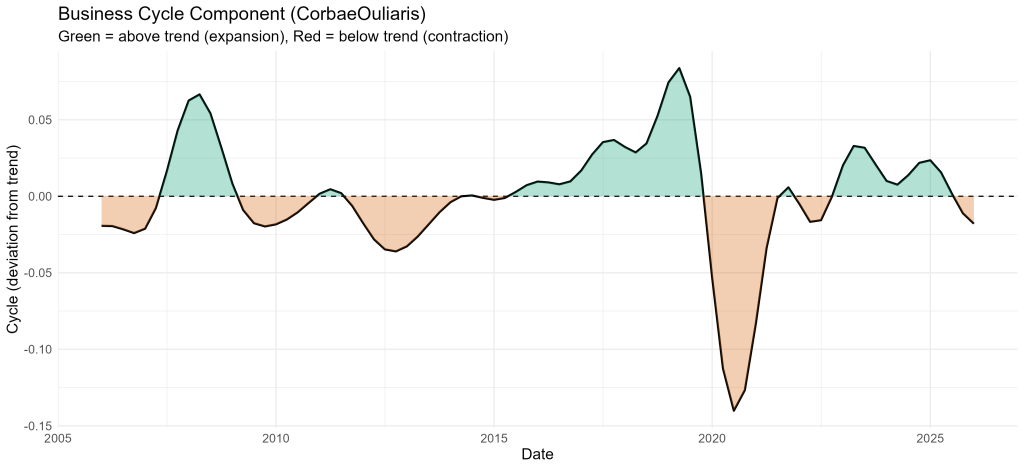
The main story is robust, even though the details differ. All three filters identify the global-financial-crisis period as a downturn, the late 2010s as a strong above-trend phase, COVID-19 as the dominant negative shock and the immediate post-pandemic period as a rebound. The greatest uncertainty concerns the latest years. HP is more cautious and places Montenegro below trend from 2023Q3 onward. Corbae-Ouliaris is more favourable and sees a renewed expansion until 2025Q3. Baxter-King cannot settle the question because it loses the endpoint.
Table 4. Business cycles dating for Montenegro time series
For interpretation, the HP filter is useful as the main reference because it covers the full sample and is easy to communicate. However, for Montenegro it should be used with particular caution because the economy is highly seasonal and the pandemic shock was exceptionally large. The safest conclusion is that Montenegro moved from a sharp pandemic collapse into a strong rebound, but the most recent cyclical position is method-dependent. It is better to describe the latest period as a zone of moderation around trend than to assert a precise turning point.
Methodological appendix to Part 3
Business-cycle dating starts by separating GDP into a trend component and a cyclical component. If the cyclical component is above zero, GDP is interpreted as above trend. If it is below zero, GDP is interpreted as below trend. These positive and negative phases are then described as expansions and contractions.
The Hodrick-Prescott filter estimates a smooth trend and treats deviations from that trend as the cycle. The Baxter-King filter is a band-pass filter designed to isolate movements at business-cycle frequencies. The Corbae-Ouliaris filter is another method for extracting cycles from non-stationary data. No filter observes the true cycle directly. Each imposes assumptions. Robust interpretation should therefore focus on episodes that appear across methods, while treating endpoint turning points with caution.