
Dating North Macedonia’s business cycle
Part 3 moves from forecasting GDP to identifying North Macedonia’s business cycle. The business cycle is the movement of economic activity around its longer-term trend. This is not the same as simply asking whether GDP increased or decreased in a given quarter. An economy can grow and still be below trend, or slow down while remaining above trend. Filter-based dating therefore gives a more nuanced view of macroeconomic phases.
This analysis compares three filters: Hodrick-Prescott, Baxter-King and Corbae-Ouliaris. Each separates trend and cycle differently. The goal is not to claim that one filter gives the true cycle, but to identify episodes that are robust across methods.
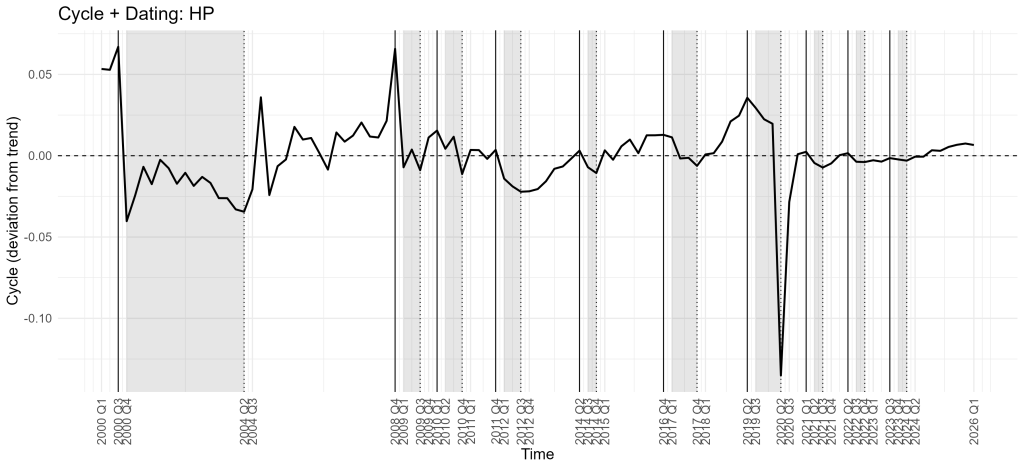
The Hodrick-Prescott filter classifies North Macedonia as being in expansion for 65 quarters and contraction for 40 quarters. The early 2000s show an initial positive phase, followed by a long below-trend period from 2000Q4 to 2004Q2. A sustained expansion then runs from 2004Q3 to 2008Q4. The global financial crisis appears as a contraction from 2009Q1 to 2009Q3. The following years are more segmented, with shorter phases of expansion and contraction. The period from 2015Q1 to 2016Q4 is above trend, followed by contraction during 2017. Another expansion appears from 2018Q1 to 2019Q2. The pandemic contraction is dated from 2019Q3 to 2020Q2, followed by a recovery in 2020Q3–2021Q1. After several shorter phases, the HP filter classifies the latest period, from 2024Q2 to 2026Q1, as above trend.

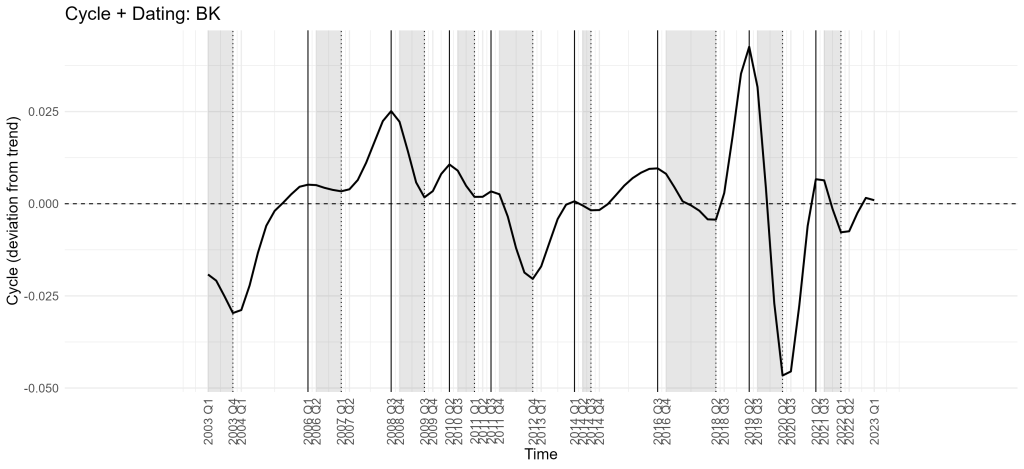
The Baxter-King filter gives a smoother but shorter view because it loses observations at the beginning and end of the sample. It identifies 45 expansion quarters and 36 contraction quarters. It confirms the mid-2000s expansion, the 2008–2009 contraction, several shorter post-crisis phases, the pandemic contraction from 2019Q3 to 2020Q2 and a recovery from 2020Q3 to 2021Q2. It also identifies expansion from 2022Q2 to 2023Q1, but cannot assess the latest years because of endpoint loss.

The Corbae-Ouliaris filter records 53 expansion quarters and 52 contraction quarters, giving a more balanced division between positive and negative phases. It identifies a below-trend phase in the early 2000s, expansion from 2004Q2 to 2006Q4, a brief interruption in 2007, and another expansion from 2007Q3 to 2008Q2. It dates the global-financial-crisis contraction from 2008Q3 to 2009Q3. It then places 2010Q2–2012Q4 below trend, followed by a long expansion from 2013Q1 to 2016Q2. The pandemic contraction is dated from 2019Q3 to 2020Q3, followed by expansion from 2020Q4 to 2021Q3. In the latest years it shows several short phases, ending with expansion from 2025Q3 to 2026Q1.
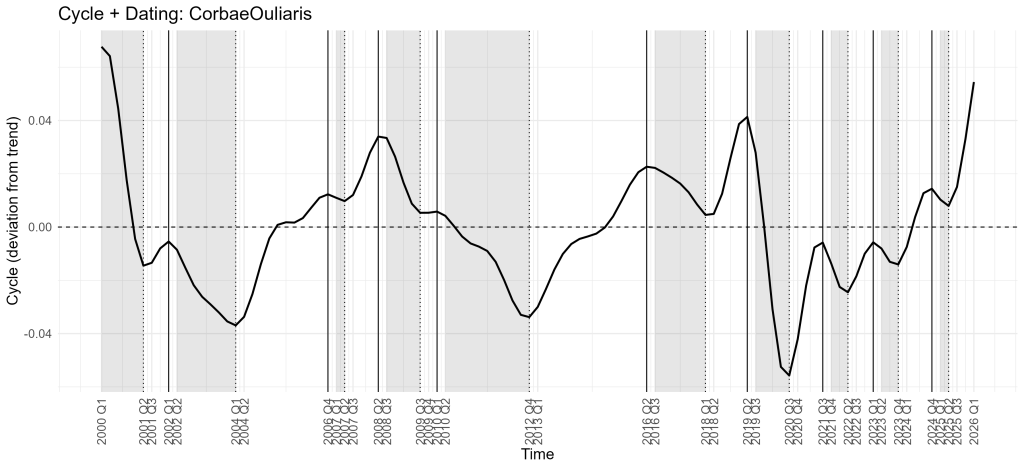

The three filters agree on the main historical episodes. The mid-2000s are generally above trend; the global financial crisis is a negative phase; the pandemic is a clearly negative shock; and the post-pandemic period includes recovery. They differ more in the 2010s and in the most recent years. HP is relatively favourable at the end of the sample, classifying 2024Q2–2026Q1 as above trend. Corbae-Ouliaris also ends in expansion but shows more short alternations before that. Baxter-King is not useful at the endpoint because of its moving-window construction.
Table 4. Business cycles dating for North Macedonia time series
For interpretation, the HP filter is the most convenient main reference because it covers the full sample and is easy to communicate. However, it should not be used mechanically. Corbae-Ouliaris is helpful because it confirms many of the major phases while showing more balance between expansions and contractions. Baxter-King is useful as a robustness check for the middle of the sample. The safest conclusion is that North Macedonia’s business cycle is less dominated by one or two large shocks than the cycles of Croatia or Montenegro. It is instead characterised by persistent growth with several moderate cyclical interruptions, a visible pandemic shock and a recent return to an above-trend position.
Methodological appendix to Part 3
Business-cycle dating starts by separating GDP into a trend component and a cyclical component. If the cyclical component is above zero, GDP is interpreted as above trend. If it is below zero, GDP is interpreted as below trend. These positive and negative phases are then described as expansions and contractions.
The Hodrick-Prescott filter estimates a smooth trend and treats deviations from that trend as the cycle. The Baxter-King filter is a band-pass filter designed to isolate movements at business-cycle frequencies. The Corbae-Ouliaris filter is another method for extracting cycles from non-stationary data. No filter observes the true cycle directly. Each imposes assumptions. Robust interpretation should therefore focus on episodes that appear across methods, while treating endpoint turning points with caution.