
Six economies, one “law”, and a region that keeps breaking the ruler – Part III

1. One region, many transitions, and a stubborn macro relationship
In the study’s telling, the appeal of Okun’s Law is disarmingly simple: when output is rising briskly, unemployment should, on average, edge down; when output falters, joblessness tends to rise. Arthur Okun framed it as an empirical observation rather than a theorem, but policymakers have treated it as a kind of operating manual ever since, especially when they need a quick translation between “growth news” and “jobs news”.
What makes this study interesting is not that it re-stages the debate in a vacuum, but that it drops the debate into a region where “the same shock” rarely means “the same outcome”. The six economies that emerged from the former Yugoslav space, Bosnia and Herzegovina, Croatia, Montenegro, North Macedonia, Serbia, and Slovenia, share a legacy of transition, but not a single macro trajectory. The study emphasises war and post-conflict recovery, market reforms, and repeated external shocks, with divergent institutional and labour-market settings layered on top. It also stresses a European integration gradient: Slovenia joined the European Union and the Eurozone relatively early followed by Croatia, while others remain in “still reforming” mode.
If there were ever a place for Okun’s Law to misbehave, this would be it. And yet the study’s conclusion is not “the law is dead”. It is closer to: “the law is alive, but only if you ask it the right question”.
2. What the combined evidence actually says
Start with the most honest summary the study offers: the pictures and the statistics point in the same direction, but not with the same volume in every country, or under every specification. The graphical evidence is described as “mixed but generally supportive” of the core inverse relationship between economic activity and unemployment.
Even within the graphs, the report highlights a regularity that will feel familiar to anyone who has ever tried to forecast unemployment from growth: the forward relationship (output → unemployment) looks clearer than the reverse (unemployment → output). In the scatterplots, reverse-causality patterns are described as weak and ambiguous, and the report notes that changes in unemployment may not reliably predict GDP growth at annual frequency.
The second headline is heterogeneity. Some countries “consistently conform” to theoretical expectations, while others look noisier, weaker, or both. In the report’s own shorthand: Croatia and Slovenia look like the tidy students; Bosnia and Herzegovina and Montenegro look like the ones whose homework was done on a bus, in pencil, during a pothole season.
But the study’s deeper claim is methodological: when the relationship is tested in ways that respect nonstationarity, heterogeneity, cross-sectional dependence, and structural breaks, the long-run link shows up more reliably, especially in the “gap” framing used later in the modelling pipeline.
3. Where the relationship looks strongest, and where it leaks
3.1 The early evidence: Where the graphs point
The study lays out a seven-figure graphical analysis, explicitly covering both forward and reverse directions, and both “first difference” and “gap” formulations.
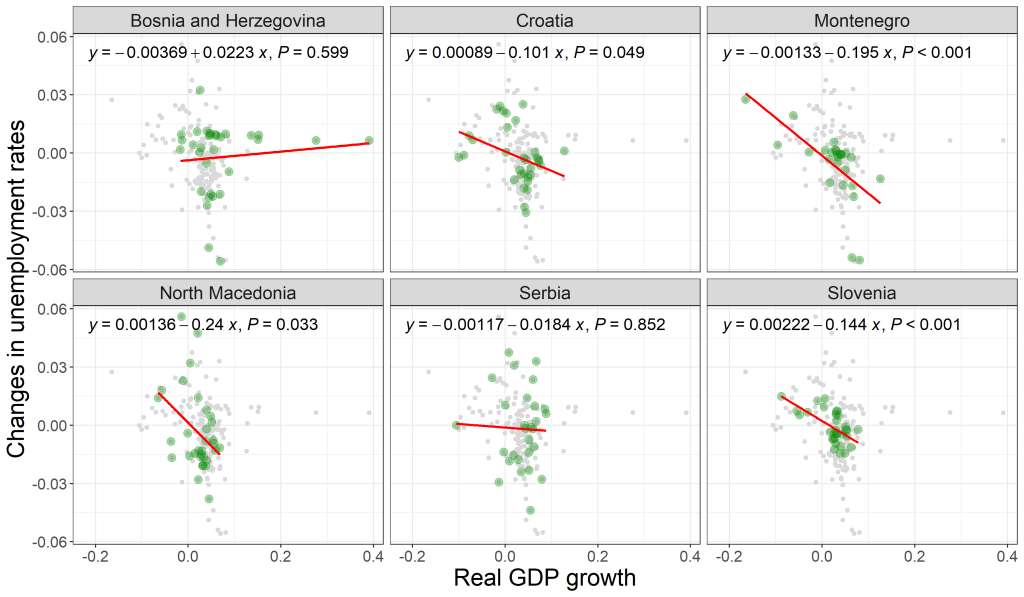
As shown in Figure 1 in the forward direction, the study describes statistically significant negative slopes in the first-difference scatterplots for Croatia, Montenegro, North Macedonia and Slovenia (with Serbia and Bosnia and Herzegovina weaker and not statistically significant).
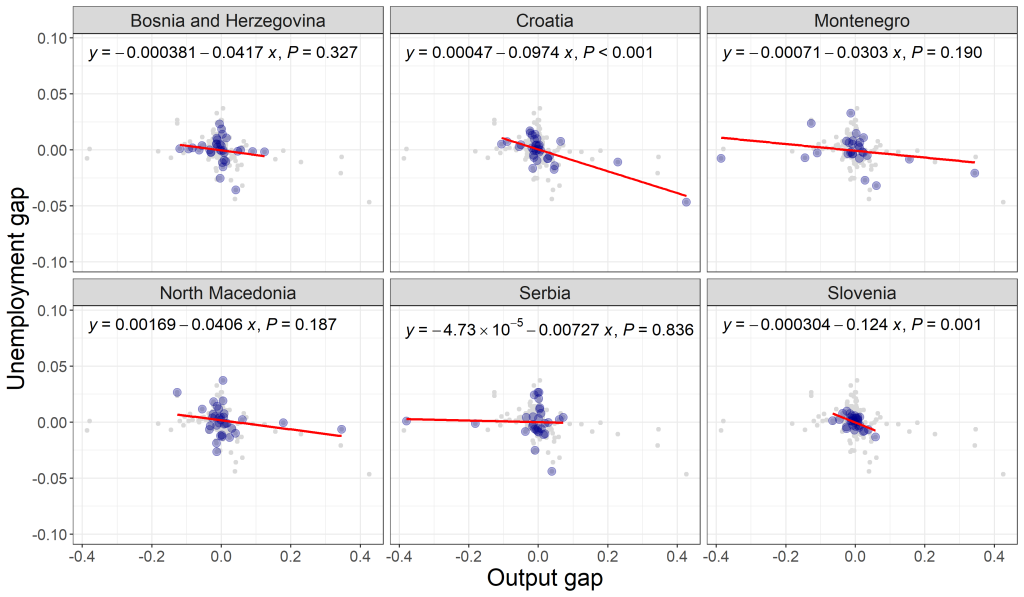
As shown in Figure 2 the gap scatterplots (output gap vs unemployment gap) also generally slope the right way, but the report is explicit that only Croatia and Slovenia show statistically significant Okun coefficients there, with more dispersion elsewhere, and it flags sensitivity to filtering and HP-filter assumptions as a practical vulnerability.
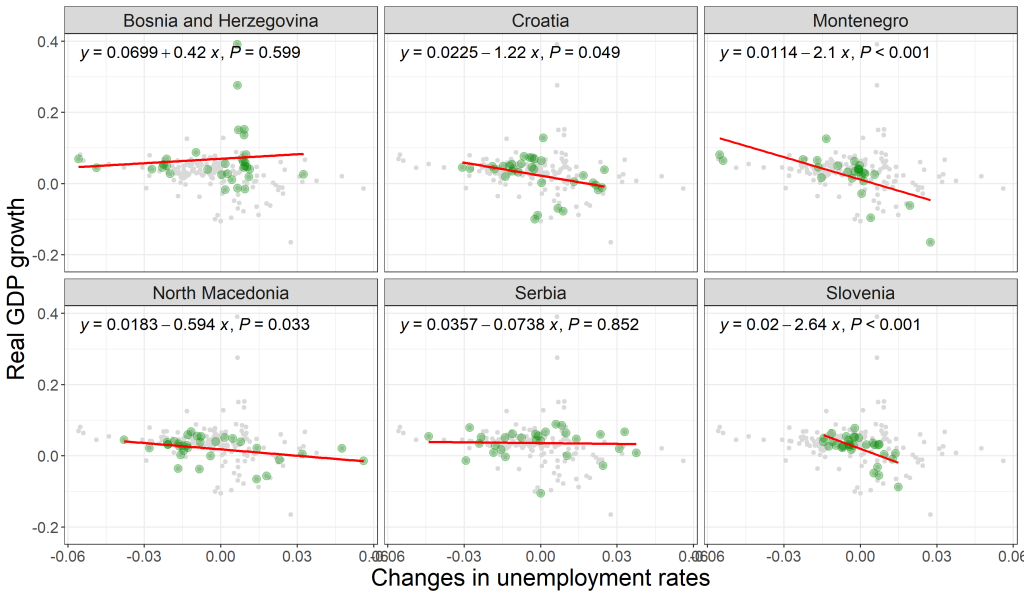
Then the reverse direction gets its turn (Figure 3). The report finds the reverse relationship “much less pronounced”, again hinting that “unemployment → growth” is a harder story to tell cleanly at this frequency.
And for the gap version of the reverse direction (Figure 4):
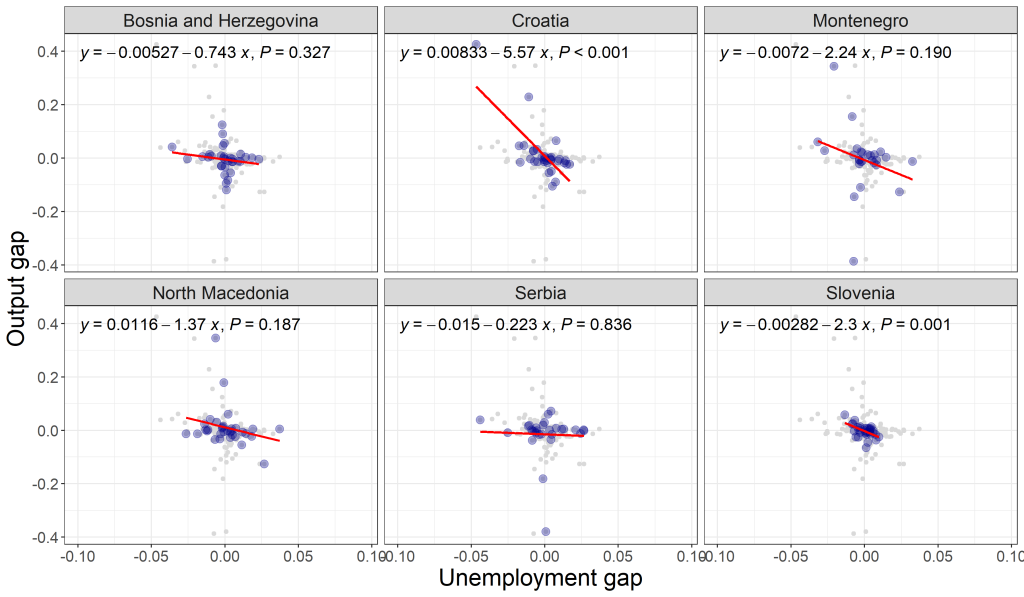
The study’s own comparative verdict from the graphical stage is crisp: the relationship is stronger in the first-difference model than the gap model (in the raw scatter stage), and “more robust when causality runs from output to unemployment”.
3.2 The modelling synthesis: Which specification wins the policy argument
Here the study pulls a neat trick: it acknowledges that gap scatterplots look noisier for several countries, and yet still argues that the gap-based modelling framework ends up being the most policy-relevant and robust once diagnostics, cointegration, and adjustment dynamics are taken seriously.
In the synthesis section, it is even more specific. It claims that only the models with unemployment gap as the dependent variable (ARDL and NARDL) show “strong and consistent cointegration”, and that the ARDL gap model is the “most robust and interpretable”. In other words: if you want one empirical object to carry into policy discussion, the report would hand you the gap-ARDL and say, “Don’t drop this.”
That preference matters because it reframes the practical meaning of Okun’s Law. In the gap version, the report reads the relationship as being about cyclical slack: deviations from potential output mapping into cyclical unemployment, with adjustment dynamics that “suggest relatively rapid convergence to equilibrium in the labour market.” That is precisely the language policymakers use when they justify counter-cyclical demand management, especially in downturns.
3.3 Where it leaks: Asymmetry, breaks, and small-sample fragility
The study is not shy about the reasons the relationship “leaks”. First, it argues that short-run asymmetry is real: contractions raise unemployment more strongly than expansions lower it (in the NARDL short-run results), while long-run asymmetry is not supported. This asymmetry is economically intuitive even without technical scaffolding: firing can be swift; rehiring can be slow; and labour-market damage can persist even after GDP bounces.
Second, it emphasises structural change. The study explicitly treats the region as one where regime shifts, wars, transitions, and institutional reforms can weaken the stability assumptions behind standard tests, particularly causality tests that assume parameter stability.
Third, it flags what every econometric result fears most: being overconfident in a moderate sample. The synthesis notes diagnostic issues (such as non-normality) and moderate sample size, warning that inference is sensitive to residual properties and breaks, even while arguing that the qualitative conclusions remain credible.
4. Country positioning and EU-stage context, careful, generic, and useful
The study itself gives only a light-touch Europe story, but it is enough for a cautious comparative frame: Slovenia and Croatia are portrayed as more stable and more aligned with the “expected” Okun patterns, while other countries show weaker, noisier, or more volatile links, potentially reflecting institutional maturity, labour-market flexibility, industrial structure, data quality, and broader development stage.
From that, you can extract a policy-relevant (and deliberately generic) EU-stage context without pretending it is causal proof. EU members tend to face stronger pressure for statistical harmonisation, policy-rule discipline, and institutional convergence; candidates and potential candidates are often still in reform mode, where labour-market institutions and enforcement can be uneven. The study’s own phrasing, “diversity in institutional maturity” and labour-market flexibility across the six, invites that interpretation, while warning you not to turn it into a morality play.
The point is not that “EU-ness” makes Okun’s Law true. The point is that institutional and policy frameworks affect how fast output shocks translate into labour reallocation, how quickly unemployment adjusts, and how cleanly unemployment statistics capture slack, precisely the channels that make Okun coefficients look stable in some places and unruly in others.
5. Practical policy takeaways, what the report implies, without pretending to be a manifesto
The study’s policy logic is built around three connected claims.
First, if the gap-based Okun relationship is empirically strong, then demand management that closes the output gap should also reduce cyclical unemployment. The study explicitly interprets the strong short- and long-run associations in the gap models as supportive of fiscal or monetary expansion during downturns to mitigate unemployment.
Second, because the short-run response is asymmetric, recessions are dangerous in a particular way: output losses generate disproportionately large unemployment increases, so delayed stabilisation can leave scars. The study says this “underscores the urgency of swift policy intervention during recessions” and cautions against reading GDP recoveries as full labour-market recoveries.
Third, causality results push the reader away from one-dimensional policy narratives. The study finds moderate-to-strong evidence that GDP changes predict unemployment changes in levels; it also warns that bidirectional predictive feedback may exist (especially under the JKS approach), which, economically, means high unemployment can also drag on future output via demand or productivity channels, implying “dual-intervention” strategies rather than growth-only thinking.
With that in mind, the study’s own “recommended policy actions” can be stated plainly (and yes, this is the one place we’ll allow a small bullet cluster, because governments love checklists even when economies refuse to be one):
- Stabilise output in downturns using fiscal and monetary tools to reduce output gaps, because closing the output gap reduces cyclical unemployment.
- Build labour-market resilience, flexible work arrangements, reskilling, and mobility incentives, to speed adjustment and reduce the risk that short-run shocks become long-run joblessness.
- Treat the cycle asymmetrically: avoid premature tightening in fragile recoveries, because unemployment responds more painfully to contractions than it rewards expansions.
The study also notes the logic of regional coordination given shared cycles and interlinkages, an argument that becomes more plausible, not less, when cross-sectional dependence is taken seriously in the diagnostics and model design.
6. What readers should watch next as these economies converge, or don’t
The study ends with a tone that is simultaneously confident and wary, which is exactly right for this kind of work. It argues that the convergence of evidence, especially in the gap-based ARDL framework, offers a “stable empirical foundation” for policy formulation, while still flagging breaks, sample limitations, and the need for robustness checks and richer nonlinear or time-varying approaches.
So what should a reader take away?
One: Okun’s Law “holds” here in the only way it ever really holds, unevenly, conditional on specification, and strongly dependent on whether you treat macro data as stationary truths or as time series with scars. The study repeatedly insists that you must respect cross-country heterogeneity, cross-sectional dependence, and structural change if you want inference that is more than decorative.
Two: the policy message is not “just grow faster”. The study’s own interpretation is explicitly twofold: reducing unemployment, especially structural and long-term unemployment, can have substantial positive effects on output, and growth policy may have limited long-run unemployment effects unless paired with labour-market reforms that improve employability, reduce mismatches, or raise participation.
Three: in a region that has lived through breaks, it is naïve to expect a single coefficient to behave like a universal constant. The study shows that instability is not a nuisance; it is the subject.
And if that sounds like we have returned to the beginning, good. In this series, the “law” is not the point. The point is what it tells you about how these labour markets absorb shocks, how output cycles translate into human outcomes, and why policy that ignores the asymmetries tends to discover them the hard way.
References
Bai, J., & Perron, P. (1998). Estimating and testing linear models with multiple structural changes. Econometrica, 66(1), 47–78. DOI: https://doi.org/10.2307/2998540
Ditzen, J., Karavias, Y., & Westerlund, J. (2024). Multiple structural breaks in interactive effects panel data models. Journal of Applied Econometrics, 40(1), 74–88. DOI: https://doi.org/10.1002/jae.3097
Hodrick, R. J., & Prescott, E. C. (1997). Postwar U.S. business cycles: An empirical investigation. Journal of Money, Credit, and Banking, 29(1), 1–16. DOI: https://doi.org/10.2307/2953682
Juodis, A., Karavias, Y., & Sarafidis, V. (2021). A homogeneous approach to testing for Granger non-causality in heterogeneous panels. Empirical Economics, 60, 93–112. DOI: https://doi.org/10.1007/s00181-020-01970-9
Pedroni, P. (1999). Critical values for cointegration tests in heterogeneous panels with multiple regressors. Oxford Bulletin of Economics and Statistics, 61, 653–670.
Pedroni, P. (2004). Panel cointegration: Asymptotic and finite sample properties of pooled time series tests with an application to the PPP hypothesis. Econometric Theory, 20, 597–625. DOI: https://doi.org/10.1017/S0266466604203073
Pesaran, M. H. (2004). General diagnostic tests for cross-section dependence in panels. CESifo Working Paper Series No. 1229.
Pesaran, M. H. (2007). A simple panel unit root test in the presence of cross-section dependence. Journal of Applied Econometrics, 22(2), 265–312. DOI: https://doi.org/10.1002/jae.951
Pesaran, M. H. (2015). Testing weak cross-sectional dependence in large panels. Econometric Reviews, 34(6–10), 1089–1117. DOI: https://doi.org/10.1080/07474938.2014.956623
Pesaran, M. H. (2021). General diagnostic tests for cross-sectional dependence in panels. Empirical Economics, 60, 13–50. DOI: https://doi.org/10.1007/s00181-020-01875-7
Pesaran, M. H., Shin, Y., & Smith, R. J. (2001). Bounds testing approaches to the analysis of level relationships. Journal of Applied Econometrics, 16(3), 289–326. DOI: https://doi.org/10.1002/jae.616
Pesaran, M. H., & Yamagata, T. (2008). Testing slope homogeneity in large panels. Journal of Econometrics, 142(1), 50–93. DOI: https://doi.org/10.1016/j.jeconom.2007.05.010
Westerlund, J. (2007). Testing for error correction in panel data. Oxford Bulletin of Economics and Statistics, 69(6), 709–748. DOI: https://doi.org/10.1111/j.1468-0084.2007.00477.x
Xiao, J., Karavias, Y., Juodis, A., Sarafidis, V., & Ditzen, J. (2023). Improved tests for Granger noncausality in panel data. The Stata Journal, 23(1), 230-242. DOI: https://doi.org/10.1177/1536867X231162034